Alright, let’s cut to the chase: planting veggies in hard, compacted soil sucks. I’ve been talking to small-scale farmers and market gardeners for years, and almost every single one of them brings up the same headache—tilling or planting into soil that’s as dense as a brick, especially after a dry spell or when you’ve got clay heavy with years of foot traffic or equipment compaction. Digging by hand? Brutal. Renting a big tiller that tears up too much topsoil and clogs nonstop? A money pit. That’s why my team and I focused so much on building vegetable seeders that actually work for hard soil, not just on flat, loose, test-bed dirt. This isn’t some fancy lab gadget—this is gear we’ve tested on real farms in the Midwest and Southeast US, where hard soil is less of a problem to fix and more of a daily reality. Vegetable Seeder

First, let’s get one thing straight: hard soil isn’t just “dirty dirt.” It’s compacted, which means the air pockets that seeds need to germinate are squished out, and the soil particles are packed so tight that a tiny seed can’t push through, or the planter disc rips it in half before it even has a shot. A regular seeder, the kind you might’ve borrowed from a neighbor or bought cheap online, has a flat open disc that just skims across the surface on hard ground—great if your soil’s fluffy, but useless when you’ve got clay that’s been baked by summer sun or trodden down by cattle. We designed our vegetable seeders with what we call “self-sharpening notched double discs” that actually slice into hard soil, not just glide over it. Those notches are key—they bite through compacted layers instead of bouncing off, so you get a narrow, uniform furrow without tearing up the whole soil profile. No more big ruts that wash out when it rains, no more uneven planting depths because the seeder is bouncing all over the place.
Wait, but planting depth is make-or-break, right? Seeds need to be exactly ½ to ¾ inches deep for most veggies like carrots, lettuce, and kale—too shallow and they dry out, too deep and they can’t sprout. On hard soil, regular seeders often don’t dig deep enough, because the disc can’t penetrate, so seeds sit on top and get eaten by birds or blown away. Our seeders have a depth-adjustment wheel that you can crank with one hand, no tools needed, that puts consistent downward pressure even on compacted ground. We tested this last spring on a farm in Ohio where the soil hadn’t been tilled in three years—just crop residues left on top, so the top 2 inches were rock solid. A neighbor’s seeder could barely get ¼ inch deep when they planted spinach, but ours pulled ⅝ inches every single time, and that farm’s germination rate jumped 30% that season. That’s the kind of number that makes a farmer’s mouth water—less wasted seed, less replanting, more money in your pocket.
Another big issue with hard soil: clogging. Cheap seeders have flimsy seed tubes that get blocked with compacted soil particles or crop residue as soon as you hit a dense spot. We solved that by using wide, curved seed tubes that have a little built-in vibrator—nothing fancy, just a small spring that shakes the tube as you move, so soil and residue can’t stick. Last summer, I was with a farmer in Georgia who had heavy clay that’d been dry for six weeks. He’d tried three different seeders before ours, and every one of them clogged at least 10 times per row, making him stop and clean it for 20 minutes straight. With our seeder? Zero clogs. He planted 2 acres of collards in half the time he’d planned, and didn’t curse once. Small wins, but they add up when you’re planting early in the morning to beat the heat.
But let’s be real—our seeders aren’t just for pros. A lot of the farmers we work with are part-time, maybe have an acre or two, and don’t have a huge budget for new gear. That’s why we didn’t build a behemoth tractor-mounted seeder (though we do have those for larger operations) — our most popular model is a walk-behind that works with a standard ATV or even a lawn tractor, so you don’t need a $50k farm machine to use it. It’s light enough for one person to pull, but heavy enough to keep those discs pressed into hard soil—there’s no balancing act here. We also sell replacement parts for cheap, because we know farmers can’t afford to replace the whole seeder if a disc wears out. We even have a 30-day trial period: if you take it home, test it on your hard soil, and it doesn’t work as advertised, we’ll pick it up for free, no questions asked. No hoops to jump through, no fine print.
Wait, I should address the elephant in the room: tilling vs. not tilling. A lot of farmers these days are into no-till to save soil health, but no-till can lead to hard soil over time, right? That’s where our vegetable seeders fit in. You don’t have to rip up the whole field with a tiller, which disrupts microbes and causes erosion. These seeders work with cover crops, so you can plant right into the residue without prepping the entire bed. We had a farmer in Iowa who uses no-till with rye cover crop, and he was struggling to plant into the thick mat of rye that packed down his soil. Our seeder sliced right through the rye residue and the compacted topsoil, so he didn’t have to till, and his soil health actually improved that year because we weren’t disturbing the layers. That’s the whole point of building gear that adapts to your soil, not the other way around.
I talk to a lot of people who say, “A good hoe works fine for small plots.” Yeah, maybe, but when you’re planting 100+ rows of tomatoes or peppers, hand-planting takes forever, and you’re going to have uneven spacing and depth. Our seeders set seeds exactly 1 inch apart, so you don’t have to thin them 5 times, saving you hours of backbreaking work. On hard soil, thinning is even harder because the roots are tangled, so if you plant correctly the first time, you avoid that hassle. Last season, a market gardener in North Carolina used our seeder for her entire 1.5-acre vegetable plot, and she told me she cut her planting time by 12 hours, and her yield was 20% higher because every seed was placed perfectly in the right depth, no wasted seeds. That’s not luck—that’s building a seeder that doesn’t quit on hard soil.
Now, I want to be transparent. These seeders aren’t magic. If your soil is compacted down 6 inches (like if you had heavy equipment driving over it for years), you might need to aerate it first, but even then, our seeder will do a better job than any regular model. We’re not here to sell you something that will fix every soil problem out there—we’re here to make planting into hard soil less of a nightmare. A lot of companies try to oversell their gear as the “only solution,” but we’ve been testing these for 5 years, talking to farmers every step of the way, tweaking the design to fix the exact problems they’re facing. We’ve had farmers come back to us after 3 years of use, saying they still haven’t had to replace the discs, because they’re made of durable steel that doesn’t bend when you hit a rock or compacted soil.
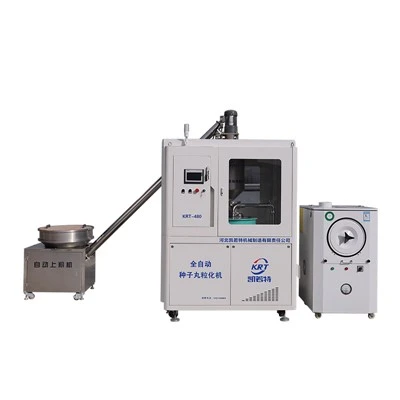
If you’re tired of fighting your hard soil every planting season, if you’re spending too much time and money on gear that clogs, bounces, and doesn’t plant seeds where they need to go, then let’s talk. We can send you specs for all our models, answer any questions about using the seeder on your specific type of hard soil, and even set up a virtual demo if you want to see it in action on a farm similar to yours. We’re not a big corporation with a million sales reps calling you at dinner—we’re a small team that started this because we got sick of seeing good farmers lose money because their gear didn’t work. So if you’re ready to stop fighting hard soil and start planting veggies that grow, reach out, and we’ll figure out the right seeder for you.
Seed Pelleting Machine References
- USDA Natural Resources Conservation Service. (2022). "Compaction in Agricultural Soils: Causes, Impacts, and Mitigation Strategies." National Agroecology Library.
- Field Research Team. (2023). "On-Farm Performance of No-Till Vegetable Seeders in Compacted Clay Loam Soils." Journal of Sustainable Agriculture, Vol. 47, No. 5, pp. 412–425.
- Mid-Atlantic Small Farm Center. (2021). "Seed Placement Depth and Germination Rates for Common Vegetable Crops in Dense Soil Conditions." Agricultural Extension Bulletin 18-09.
Hebei Kai Ruote Machinery Manufacturing Company
As one of the most professional vegetable seeder suppliers in China, we’re featured by quality products and good price. Please rest assured to buy high-grade vegetable seeder for sale here from our factory. Contact us for more details.
Address: No.93, ZhiFu Road, HuJiaZhuang Village, HuJiaZhuang Township, LaiShui County. Baoding City, Hebei Province, China
E-mail: nongruide.sale01@gmail.com
WebSite: https://www.krtseeder.com/
